
Google Ads Expands Customer Match to Include IP Address and Timestamp
Identifying customer behavior online is one of the most important tools for advertisers. Online behavior can reveal users' preferences through the websites they visit and even social media comments. This data helps advertisers show more relevant ads that are more likely to attract users.
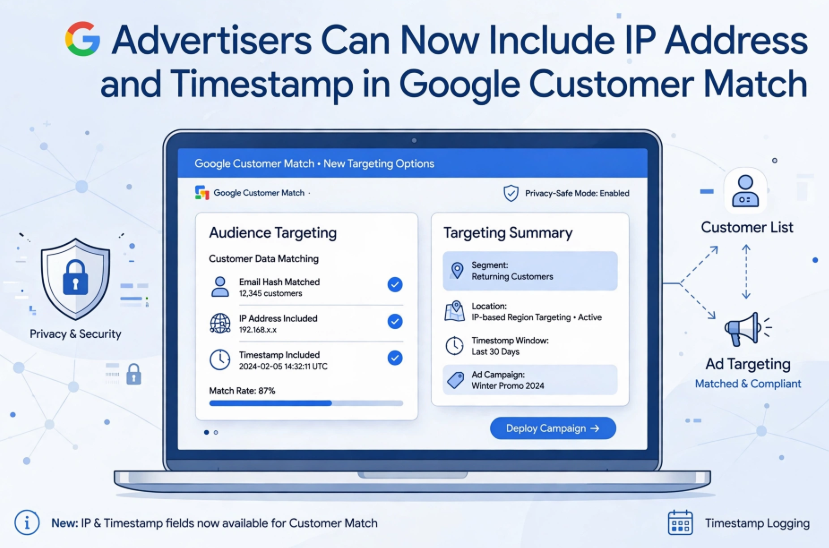
Advertisers use a plethora of tools to increase their chances of success. Among them is Google’s Customer Match. According to Google, the tool “lets you use your online and offline data to reach and re-engage with your customers across Search, the Shopping tab, Gmail, YouTube and Display.” The tool cuts through the noise by identifying customers, allowing advertisers to improve opportunities for previously interested clients.
IP Address & the Latest Update
Google’s Customer Match is a powerful advertising tool because advertisers can practically “chase” users interested in their products and/or services. While it does invade user privacy, Google’s advertising tool helps businesses work with potential customers.
The latest update to Customer Match has made it even stronger. According to Search Engine Land, “Google Ads is giving advertisers two new ways to match their first-party customer data: IP addresses and interaction timestamps.”
Previously, advertisers used simple identifiers for Customer Match. IP addresses and timestamps give advertisers more information about a user's location and when the interaction occurred. Advertisers now have an idea of when to run their ads on Google. The update also helps advertisers looking for new customers tailor their ads to avoid Customer Matches.
Take note that Google’s Customer Match with IP addresses and timestamps does not tell advertisers which uploaded records match users in Google’s database. Advertisers receive a match rate for data accuracy.
Privacy Concerns
Any transaction involving an IP address may raise privacy concerns in some countries. Specifically, Google advises that “IP matching isn’t supported for end users located in the EEA, UK, or Switzerland (CH).” Customer Match users can upload email, phone number, and mailing address as a bare minimum. Users can also upload Device ID, User_ID, IP address, and interaction timestamp when allowed. Timestamp is not allowed if the IP address is not included.
Google notes that uploading IP addresses is not allowed in select EU countries. But IP address privacy protection is not limited to EU countries. In California, the California Consumer Privacy Act (CCPA) protects consumers' personal information. However, websites can collect IP addresses with consent. If the customer agrees, then the website can use the IP address for advertising purposes such as Customer Matching.
Privacy concerns go beyond IP addresses and timestamps. Advertisers use customer data to maintain existing customers, promote new products and services, and better understand their audience. However, advertisers must follow privacy laws in certain countries and states to avoid legal issues.
Ultimately, users should be aware that advertisers are doing everything they can to track their activity. Users should be careful when sharing personal information online, especially with unfamiliar or suspicious websites. While some websites may use personal information for advertising, others could misuse it for phishing, scams, identity theft, and other illegal activities.
Comments